Villages, salt and rice
Wat Ton Laeng, the wooden-roofed temple at Pua
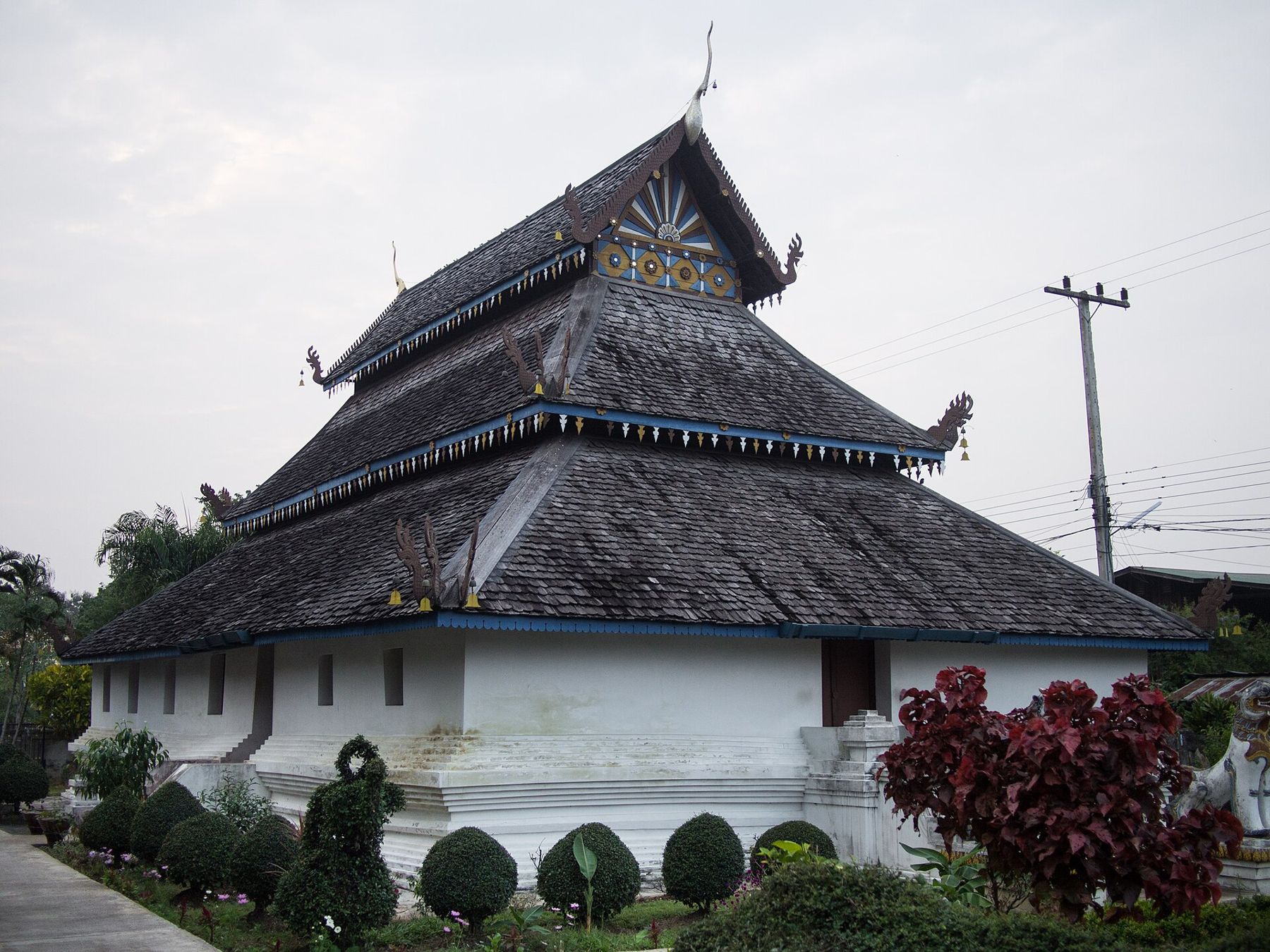
Near Pua, a village hall wears a heavy roof of wooden shingles in three tiers, its eaves pulled down low over whitewashed walls in the old Tai Lue manner.
- Getting there
- North by road to Pua district
- Bring
- Shoulder cover, hat, water, socks for warm floors
- Dress and manners
- A village temple: cover shoulders and knees, remove shoes at the steps, speak softly, and do not touch or climb on the old walls or plinth.
- From the old town
- About 60 km north by road
Some temples impress through height and gold. Wat Ton Laeng impresses through weight. Its main hall sits low on a stepped white plinth under a roof of dark wooden shingles laid in three tiers, each one sweeping down and out over the one below. The lowest eaves come so close to head height that the walls almost disappear in shadow. Seen from the lane, the building looks less like a monument than a great, quiet animal resting in the grass.
The temple stands in the village of Ban Ton Laeng in Pua district, in the broad valley north of Nan town. It is often counted among the finest surviving examples of Tai Lue temple building in the province, and it draws architecture enthusiasts, photographers and people on the road north who have heard about its roof.
Who the Tai Lue are
The Tai Lue are a Tai-speaking people whose homeland lies in Sipsongpanna, in what is now southern Yunnan in China. Over several centuries, groups of Tai Lue moved or were moved south into what are now Laos and northern Thailand, and many settled in the valleys of Nan. Pua and the neighbouring districts still have strong Tai Lue communities, known for their language, food, festivals and especially their weaving, which you can read more about in the story of Tai Lue textiles.
Their temples share a recognisable look. Halls tend to be compact and solid, with thick masonry walls, small window openings and a heavy, low roof broken into tiers. Decoration is used sparingly and concentrated in a few places, such as the gable ends and the guardians at the stairs. Wat Ton Laeng shows this style with unusual clarity.
The roof
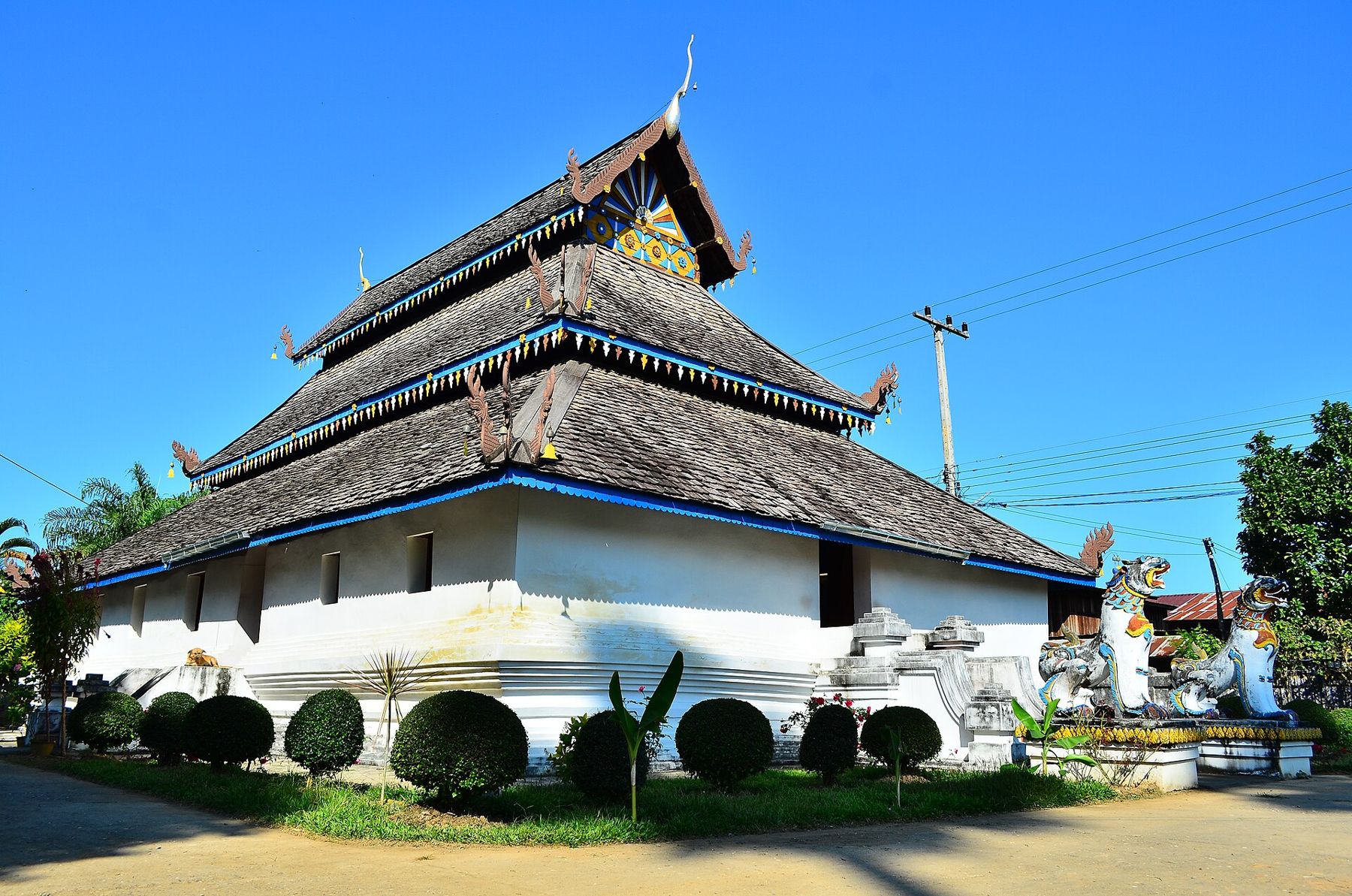
The roof is the reason to come. It is laid with small wooden shingles rather than clay tiles, and over time they have weathered to a soft grey-brown. Three tiers step down from the ridge, and the lowest layer runs right around the hall, so the eaves stand very close to the ground on every side. Narrow carved boards trimmed in blue run along the edges, and at the corners small carved finials curl up like flames or the heads of mythical creatures.
The upper gable carries a small sunburst panel in blue, gold and white, a bright point in an otherwise sober building. A slender finial rises from the very top. Walk all the way around and watch how the tiers overlap: from some angles the roof reads as a single steep pyramid, from others as a stack of separate wings.
A roof like this needs care. Wooden shingles crack, slip and rot, and they have to be replaced by hand. The hall has been through conservation work over the years, and the fact that the shingles survive at all reflects a decision by the village and those who help it to keep the old material rather than swap it for modern tiles.
Walls, plinth and guardians
Beneath the roof, the hall stands on a raised plinth with stepped mouldings, painted white. The walls are thick and plain, pierced by a row of small, deep-set windows. This gives the interior a dim, cool atmosphere, very different from the sunny courtyard outside. The building is often described as several centuries old, though, as with most village temples that have been repaired many times, it is hard to put a single date on what you see.
Also in Nan: Pua and the rice terraces of the north
At the main stair, large guardian lions with bright painted faces stand watch, a familiar sight at northern temples. Stair rails often take the form of serpents or mythical beasts, carrying the visitor symbolically from the everyday world into the sacred one. Pause at the steps to take off your shoes, and leave them neatly to one side.
Whether the hall is open depends on the day and on who is around. If the doors are closed, the exterior alone repays the trip. If they are open, step in quietly and give your eyes time to adjust to the gloom before looking for the main image.
Visiting a working village temple
Wat Ton Laeng is not a museum. Monks and villagers use it for daily and festival worship, and the grounds double as a shared space for the community. A few habits make your visit easier for everyone:
- Keep voices low and phones on silent inside the hall.
- Do not lean on, sit on or climb the plinth, walls or guardian figures; the old plaster is fragile.
- Ask before photographing monks or people at prayer, and accept a no gracefully.
- Drone flights over a temple without permission are unwelcome.
- A small donation in the box inside is a good way to thank the temple for its upkeep.
Opening times are informal and may change on holy days or during repairs. If you arrive at an awkward moment, a walk around the outside and a return later in the day is usually the best plan.
Light and timing
The shingle roof changes with the light. Under a bright cool-season sky it looks almost black against the blue, and the white walls glare. On overcast mornings the grey shingles and white plaster turn soft and even, and the carved details show more clearly. Late afternoon brings warmer light from the west and long shadows under the eaves.
The cool, dry months from roughly November to February are the most comfortable time for the trip north. The hot months that follow can be hazy, and the rains from about May bring green fields but slippery roads.
Pua makes a natural base for a day in the northern valley. Rice fields spread across the flat land around the town, and the hills rise steeply to the east. From Pua the road climbs into Doi Phu Kha National Park, steep and winding, with care needed in the rains, and continues over the range towards the salt wells at Bo Kluea. Several other temples in the valley share the Tai Lue building tradition, so if Wat Ton Laeng catches your interest, you will find echoes of it along the way.
Coming from Nan town, allow at least half a day for the drive up, the temple and a meal in Pua, and a full day if you plan to continue into the mountains.
Before: Wat Suan Tan · Next: Wat Phra That Bueng Sakat · Same topic: Bo Kluea, Pua, Wat Phra That Bueng Sakat
Images: Takeaway, CC BY-SA 3.0; k.phothiwijit, CC BY-SA 3.0.

