Villages, salt and rice
Wat Phra That Bueng Sakat in the Pua valley
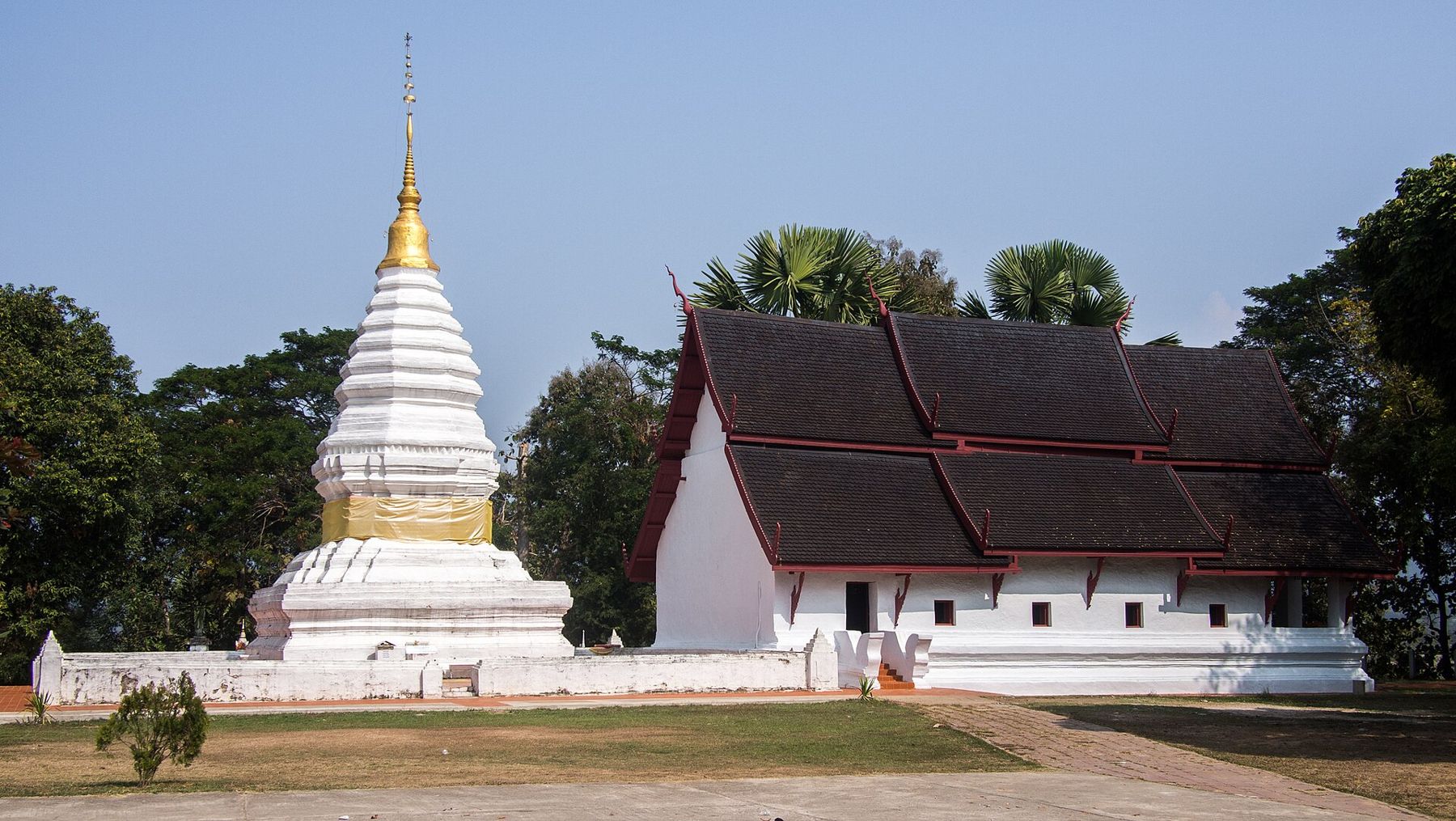
On the edge of the rice country around Pua, a white chedi with a gilded crown stands beside a low, dark-roofed hall whose interior glows with black and gold pillars.
- Getting there
- Road north to Pua, then local lanes
- Bring
- Modest clothes, sun hat, water, camera
- Dress and manners
- Cover shoulders and knees, remove shoes before the hall, and do not climb on the chedi base; the courtyard paving gets very hot by midday.
- From the old town
- Around an hour north by road
Driving north from Nan town, the valley opens out as you approach Pua. Rice fields run flat to the foot of the eastern mountains, villages gather under fruit trees, and every few kilometres a temple roof breaks the line of green. Wat Phra That Bueng Sakat is one of the most rewarding of these stops: a white chedi topped with gold, a low hall with a dark roof, and a calm compound where it is easy to spend more time than you planned.
The temple lies in Pua district, among the farming villages of the valley. It is a place of local devotion first, and a visitor's stop second, which is much of its appeal.
The chedi
The name Phra That signals a reliquary chedi, a structure that by local belief enshrines a relic of the Buddha. Local tradition holds that the chedi here does so, and that the site has been sacred for a very long time. As with many reliquary temples in the north, the story is held with deep respect, and it is best received in that spirit rather than tested against records.
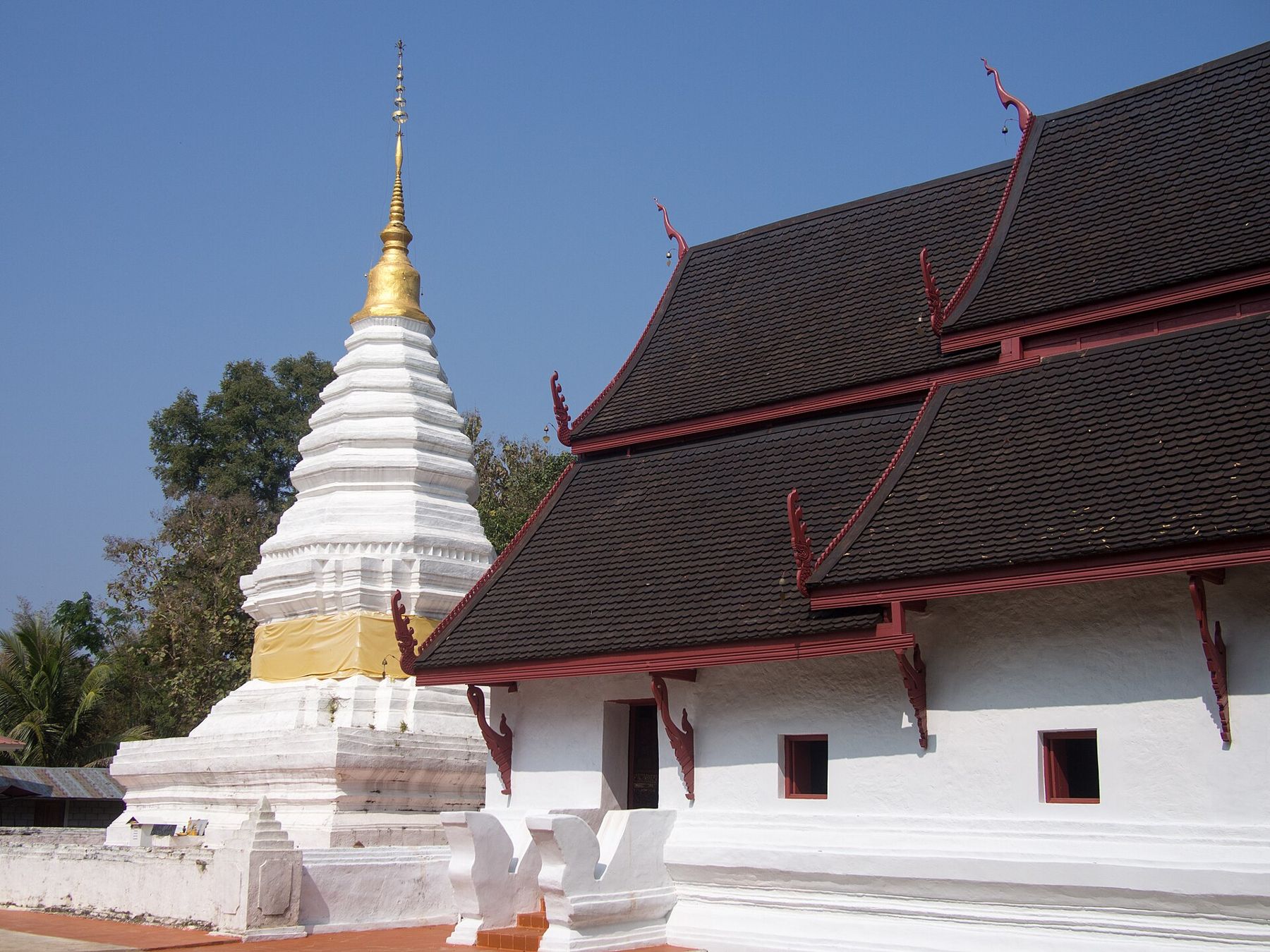
The chedi itself is a classic northern bell-shaped form. It rises from a square, stepped base through a series of rings and mouldings, narrows into a slim bell, and ends in a gilded spire. A band of gold-coloured cloth is often wrapped around its middle, a sign of offering and care. The whitewash is bright, and against the clear skies of the cool season the structure seems to float above the low wall that encloses it.
Walk around the chedi clockwise, keeping it on your right, as people do when paying respect. Do not climb the base or sit on the enclosure wall.
The hall
Next to the chedi stands the assembly hall, a long, white building under a roof of dark tiles laid in several overlapping tiers. The lower roofs drop low over the walls, and the gables are framed by red-painted boards ending in curled finials. Small windows are set deep in the thick walls. The proportions and the low, layered roofline are often described as Tai Lue in style, the building tradition shared with other village temples of the valley.
The buildings were restored in the early 2010s, so the whitewash, roofs and woodwork you see are largely the result of that work. Restoration of old village halls is a careful balance between keeping the original character and making a building sound again; here the outline remains plain and low, in keeping with the older style.
Also in Nan: Wat Phra That Chae Haeng across the river
Inside: black and gold
If the hall is open, step inside. The contrast with the white exterior is striking. Massive round pillars run down the nave in two rows, painted black and covered with gold stencilled patterns of flowers and geometric motifs. Above, a coffered wooden ceiling carries small gilded rosettes, and the timber roof frame is exposed in red and dark brown.
At the far end, a gilded seated Buddha sits on a tall, decorated base, framed by the pillars. The light comes in sideways through the small windows, so the gold catches it in patches and the rest of the hall stays dim. Stand still for a moment at the back before walking forward; the space reads best from a distance.
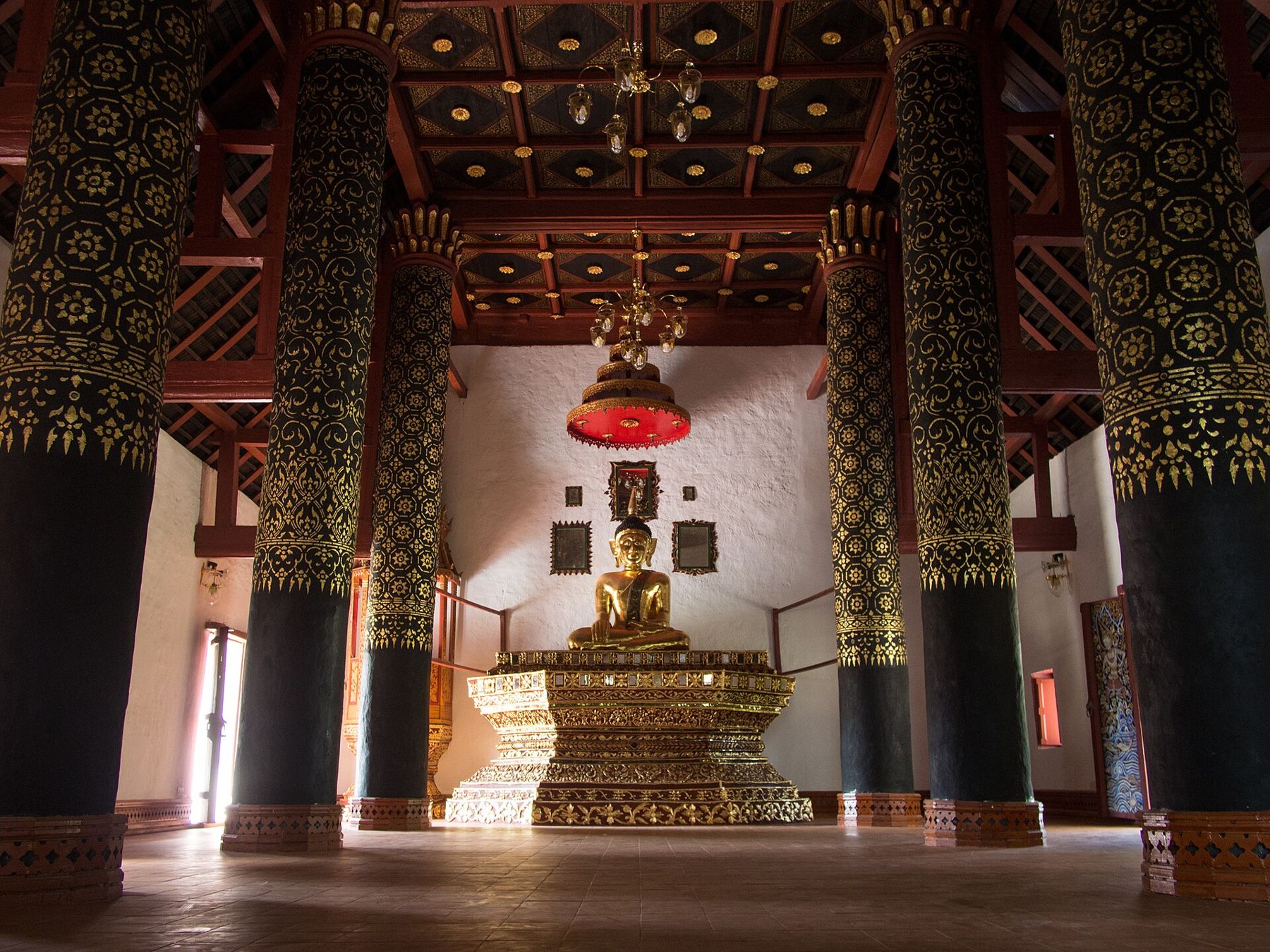
Stencilled gold on black or red lacquer is an old northern Thai technique, used on pillars, doors and manuscript chests. It is worth comparing with the interiors you see in town, at temples such as Wat Phumin and Wat Phaya Wat, where the decoration takes quite different forms.
A temple among the fields
Part of what makes Bueng Sakat worth the stop is its setting. The temple grounds are open and green, with tall trees and palms around the edges. Beyond them lie the fields of the Pua valley, which change through the year: brown stubble and smoke in the dry months, flooded paddies and young shoots after the rains begin, and gold just before harvest late in the year.
If you want to see the valley's farming landscape at its most dramatic, the terraces on the slopes above town are a short drive away; the rice terraces around Pua are at their greenest in the rains and turn golden towards harvest. Bueng Sakat gives you the flat-land version of the same story, with the temple at the centre of village life.
On the road north
Most visitors reach Wat Phra That Bueng Sakat as one stop on a longer journey. The main road from Nan town follows the valley north, and Pua is the last sizeable town before the mountains. A typical day might combine the temple with lunch in Pua, a look at other village temples nearby, and either an afternoon among the fields or a drive up into the hills.
Beyond Pua, the road into Doi Phu Kha National Park is steep and winding, with sharp bends and long climbs. In the rains, landslides and mud can make it slow and risky, so plan to be off the mountain before dark.
- The grounds are usually open from morning until early evening; the hall may be locked outside service times.
- Entry is generally free, with donation boxes inside.
- There is little shade on the paved courtyard around the chedi, so come early or late in the hot months.
- Holy days and local festivals bring crowds, music and offerings; arrangements for visitors may differ on those days.
- Times, access and repair work can change without notice, so a quick question in Pua or at the temple itself saves a wasted trip.
Give yourself at least half an hour here. The chedi and the hall can be seen in a few minutes, but the quiet of the compound and the view of the valley around it are what you will remember.
Before: Wat Ton Laeng · Next: Wat Nong Daeng · Same topic: Bo Kluea, Pua, Wat Ton Laeng
Images: Takeaway, CC BY-SA 3.0; Takeaway, CC BY-SA 3.0; Takeaway, CC BY-SA 3.0.


