Tai Lue weaving and temples
Wat Nong Daeng, a Tai Lue temple in the Nan countryside
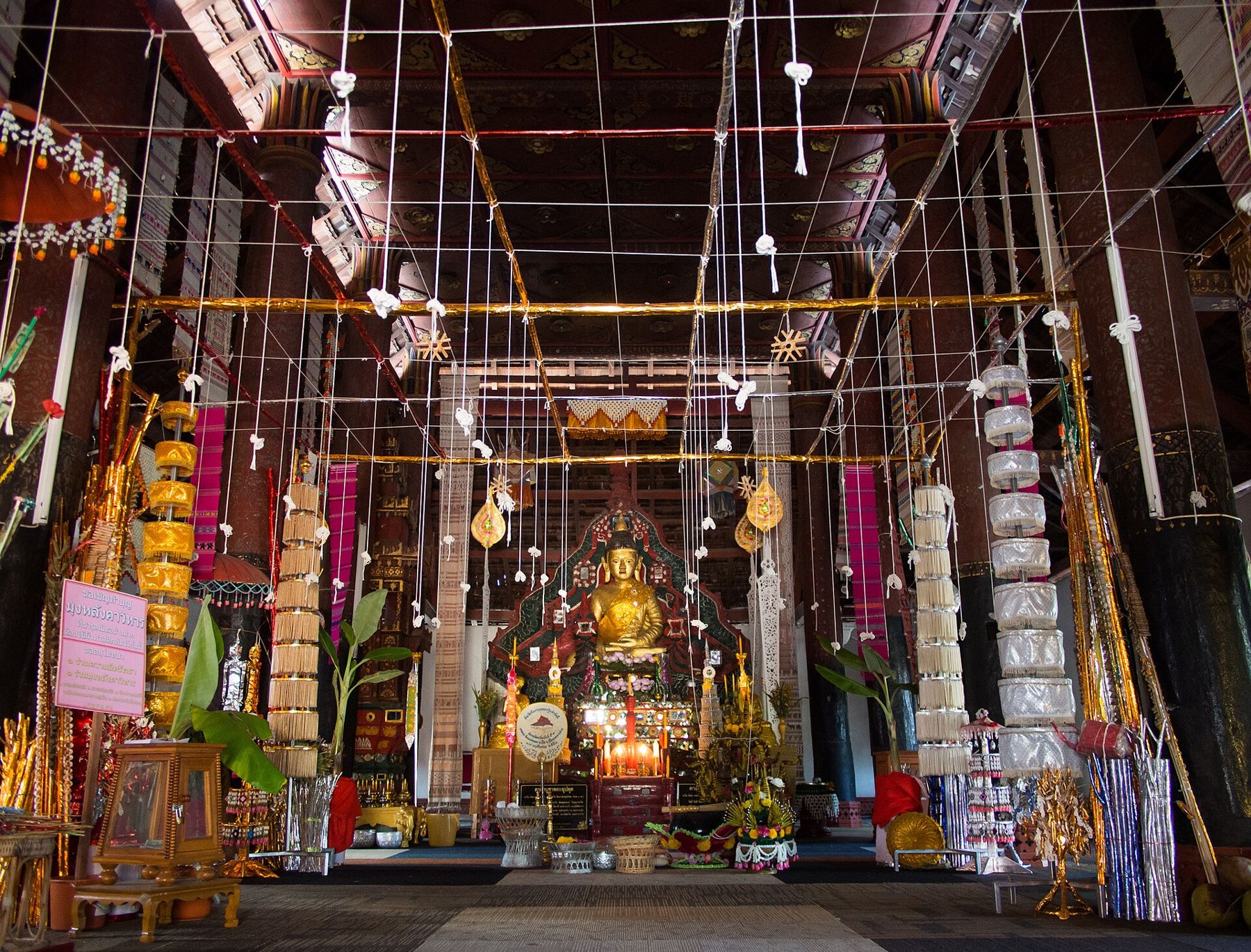
In a Tai Lue village outside Nan town, a temple hall hung with woven banners and paper offerings shows how closely worship and weaving are bound together.
- Getting there
- By road from Nan town, local directions
- Bring
- Modest clothes, small notes for donations, patience
- Dress and manners
- A living village temple: cover shoulders and knees, leave shoes at the steps, keep voices low and ask before photographing people at prayer.
- From the old town
- A countryside drive out of town
Wat Nong Daeng belongs to a Tai Lue village in the countryside of Nan, a short drive out of town among fields and orchards. It is not on most first-time itineraries, and it is not dressed up for visitors. That is exactly why it is worth seeking out. Here you see a Tai Lue temple as its community uses it: a hall full of woven banners, paper ornaments and offerings, with the faded traces of older paintings behind the main image.
This is a place to go slowly and quietly, and to treat as someone else's place of worship rather than a sight.
A Tai Lue village temple
The Tai Lue trace their origins to Sipsongpanna in southern Yunnan. Over the centuries, Tai Lue communities settled in the valleys of northern Laos and northern Thailand, and Nan province has a number of Tai Lue villages that keep their own dialect, dress and customs. Village temples are at the heart of this life, and their buildings tend to follow a recognisable pattern.
Wat Nong Daeng's main hall follows it. Seen from outside, the roof steps down in layers, with low eaves and finials at the corners, and the stairs at the entrance are framed by serpent-like naga balustrades, their bodies running down the rails and their heads rearing at the foot. The walls are solid and the windows modest, so the interior is cool and shaded. It shares this family resemblance with other Tai Lue temples in the province, from the valley north of town to the rice country around Pua.
Inside the hall
The interior is what stays with you. Strings run from wall to wall above the nave, hung with small white paper and cloth ornaments that turn gently in the air. Long banners, called tung, hang from the beams and pillars, some woven in narrow bands of colour, some made of paper and some of cloth. Tall offering towers in silver, gold and white stand along the sides, and at the far end a gilded Buddha sits before an ornate backdrop, surrounded by flowers, candles and gifts.
Much of this decoration is made by the villagers themselves and renewed for festivals and merit-making ceremonies. A banner might be woven to make merit for a family member, or offered at a particular point in the year. The hall therefore changes from season to season, and two visits a few months apart may look quite different.
Also in Nan: Walking Nan's old town
Weaving and worship
For Tai Lue communities, weaving has long been more than a craft for clothing. Textiles are made as offerings, and temple banners are one of the clearest examples. Tung can be long and narrow, with patterns that echo the motifs of Tai Lue skirts and shoulder cloths: diamonds, stylised animals, temple shapes and bands of colour. Offering a banner to a temple is understood as an act of merit, and the work that goes into weaving one is part of that offering.
The villages around Wat Nong Daeng have their own weaving traditions, and in many Tai Lue communities of Nan you may see looms under houses or cloth being sold from homes and village groups. If textiles are your interest, look at Tai Lue weaving in Nan for the patterns and techniques, and at the national museum in town for older pieces displayed with context.
Buying directly from weavers supports the craft, but there is no obligation, and a polite look is always welcome.
The unfinished mural
Behind the main image, on the back of its backdrop, are the remains of mural paintings that appear never to have been completed and have since suffered serious damage, especially in the lower half. What survives is fragmentary: faded blue and earth tones, the lines of a robe, a pair of graceful hands, an inscription in old script. One figure is often read as a dancer, though the damage makes this hard to be sure of.
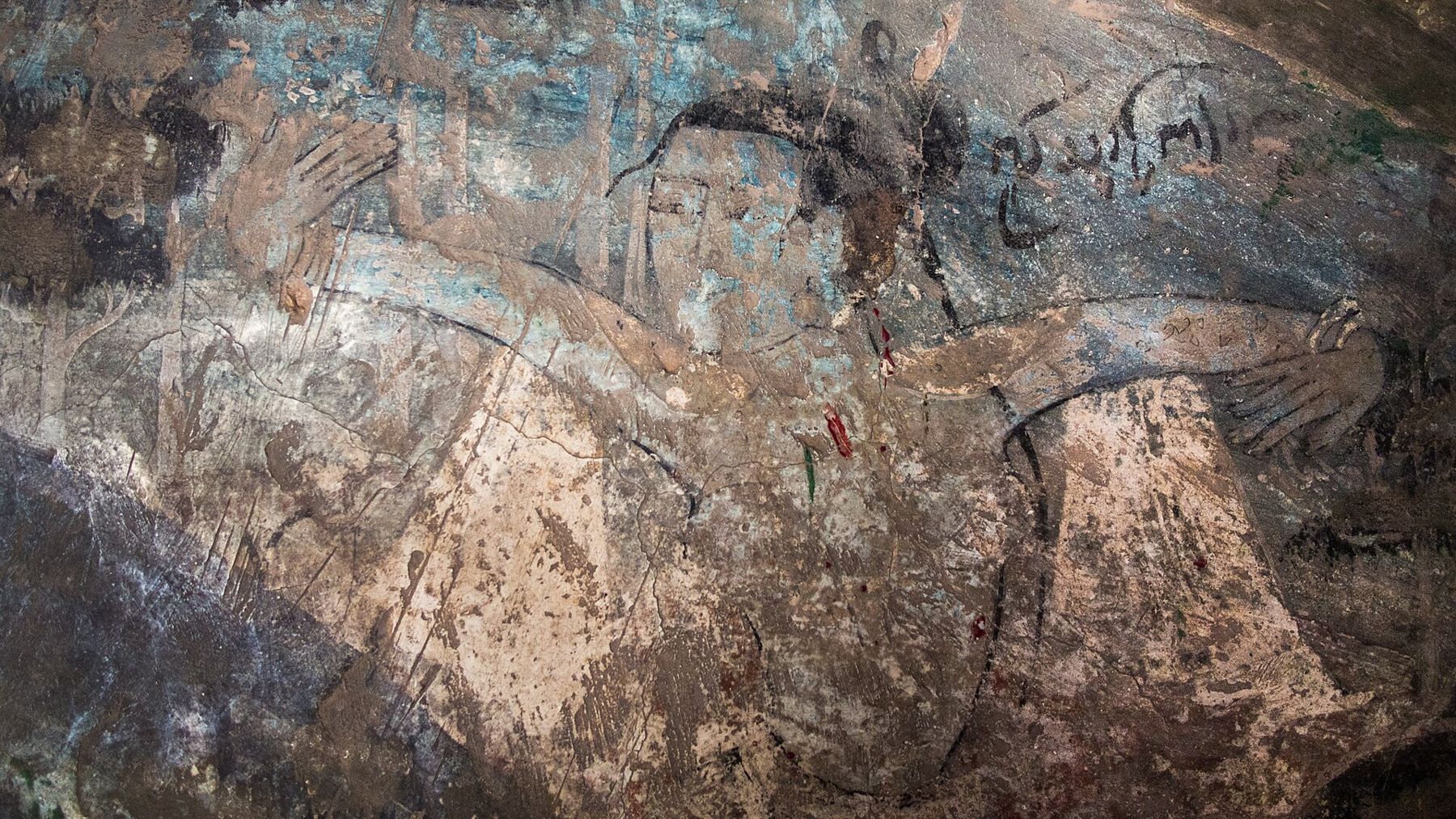
These fragments are fragile. Do not touch them, do not use flash, and keep bags and elbows clear of the wall. They are a reminder that Nan's famous murals, at Wat Phumin and at Wat Nong Bua, are only the best-preserved of a much larger tradition of temple painting in the province, much of which has faded or been lost.
Any day will show you the building and its interior, but festival days show you the temple in use. The end of Buddhist Lent, merit-making for the new year in April, and village ceremonies bring people in their best Tai Lue dress, music, food and new offerings for the hall. Dates follow the lunar calendar and local custom, so ask in town or in the village about what is planned during your stay.
The cool season, roughly November to February, is the most comfortable time for touring the countryside. The hot months are hazy and the midday heat on a temple courtyard can be punishing; the rains bring green fields and occasional muddy lanes.
- Dress modestly, covering shoulders and knees, and remove your shoes before entering the hall.
- Keep to the back or sides during ceremonies, and never walk between people and the Buddha image while they are praying.
- Ask before photographing people, especially elders and monks; many are happy to say yes, but the choice is theirs.
- Do not touch banners, offerings or the mural fragments.
- A small donation in the box is a fair thanks for the temple's welcome and upkeep.
Opening is informal, and on some days the hall may be locked. If so, a walk around the grounds and the lanes of the village is still worthwhile, and you may find someone with a key if you ask politely.
Wat Nong Daeng will not overwhelm you with size. Its strength is closeness: a hall that the community keeps filling with its own handwork, and a glimpse of how faith and the loom shape each other in Tai Lue life.
Before: Wat Phra That Bueng Sakat · Next: Wat Phumin · Same topic: Wat Nong Bua, Nan
Images: Takeaway, CC BY-SA 3.0; Takeaway, CC BY-SA 3.0.

