Temples of the old town
Wat Phra That Khao Noi and the view over the valley
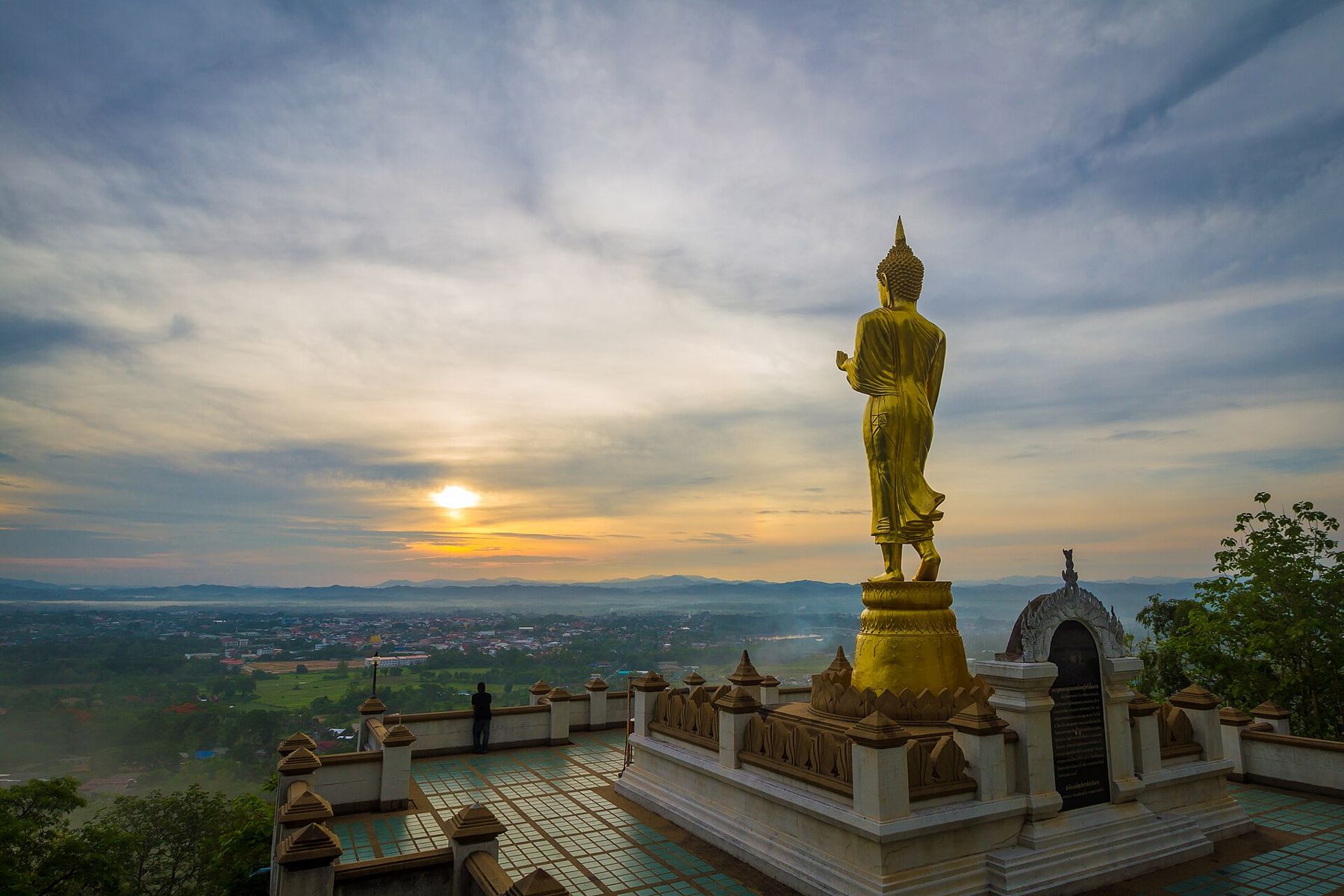
On a wooded hill just west of town, a golden standing Buddha looks out over Nan and its valley. Go up early or late, when the light is soft and the hills fade in layers.
- Getting there
- Short ride west, then steps or road
- Bring
- Water, a light jacket, shoes that grip
- Dress and manners
- Cover shoulders and knees. The stairway is long and steep, so wear shoes with grip and carry water; it is cool at dawn in winter.
- From the old town
- About two kilometres west, up a hill
Nan lies in a broad valley ringed by mountains, and the best way to understand its shape is to climb above it. Wat Phra That Khao Noi stands on a forested hill just west of the old town, and on its summit terrace a tall golden Buddha image stands facing out over the valley. From up here you see the whole town at once, the river beyond it and the ridges rising in layers to the east.
The standing Buddha
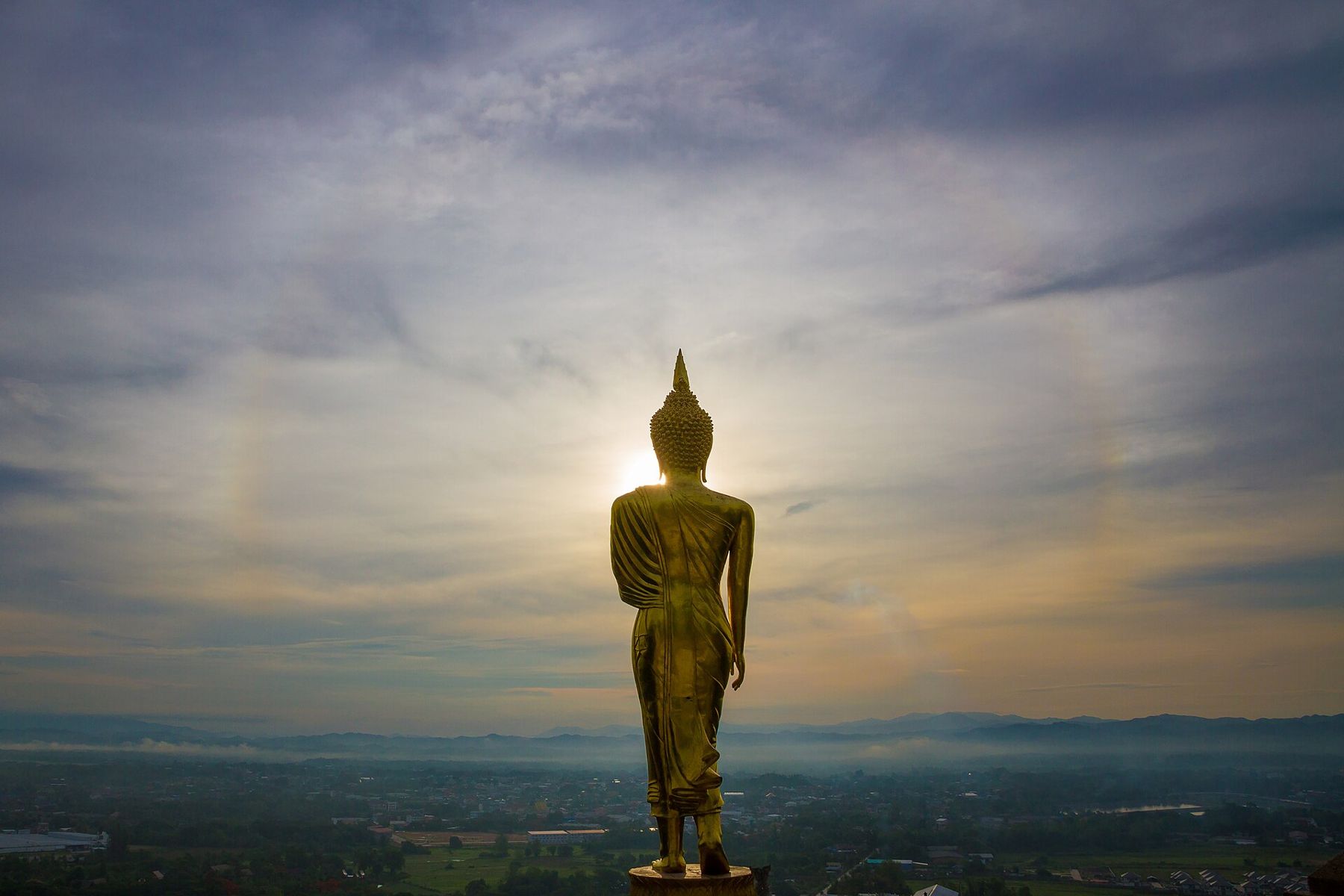
The image stands on a high pedestal at the edge of the terrace, gilded from head to foot and dressed in flowing robes. Seen from behind, as most visitors first see it, it seems to be looking over the town as a guardian, and that is how many people here think of it. The terrace around it is tiled and walled, with low balustrades where you can stand and take in the view.
Remember that this is an image of the Buddha, not a viewpoint statue. Do not climb the pedestal or the walls, do not pose in ways that would be disrespectful, such as pointing your feet towards it, and keep voices down near the shrine beneath it.
The chedi and the temple
The name Phra That tells you the hill also holds a chedi, believed to enshrine relics, and the temple buildings sit on the hilltop near the terrace. The hill has long been a place of worship, older by far than the large standing image, which is a more recent addition. Take time to pay your respects at the chedi before you turn your attention to the view.
Local people come here to make merit, especially on holy days and at the turn of the year, and you may see families offering flowers, candles and incense at the shrine below the image. If you would like to make an offering, small donations can be left in the boxes provided; there is no pressure to do so, and quiet respect is welcome on its own.
The steps up
There are two ways up. A long stairway lined with naga balustrades climbs the hillside from the foot, a few hundred steps in all, and makes a good stiff walk in the cool of the morning. A road also winds up to a car park near the top, so you can drive, ride or take a hired songthaew if the steps are too much.
Also in Nan: Wat Phra That Chae Haeng across the river
If you walk, start slowly. The steps are steep in places and can be slippery after rain, and there is little shade on some stretches. Carry water, take breaks at the landings, and come down carefully.
Sunrise and sunset
The hill is at its best at either end of the day. In the cool season, mist often fills the valley at dawn, and the town emerges slowly from it as the sun rises over the eastern hills. In the late afternoon the light falls across the valley and warms the gold of the image, and as dusk comes the town lights appear below. Both times draw local people as well as visitors, so the terrace can be busy, but rarely crowded.
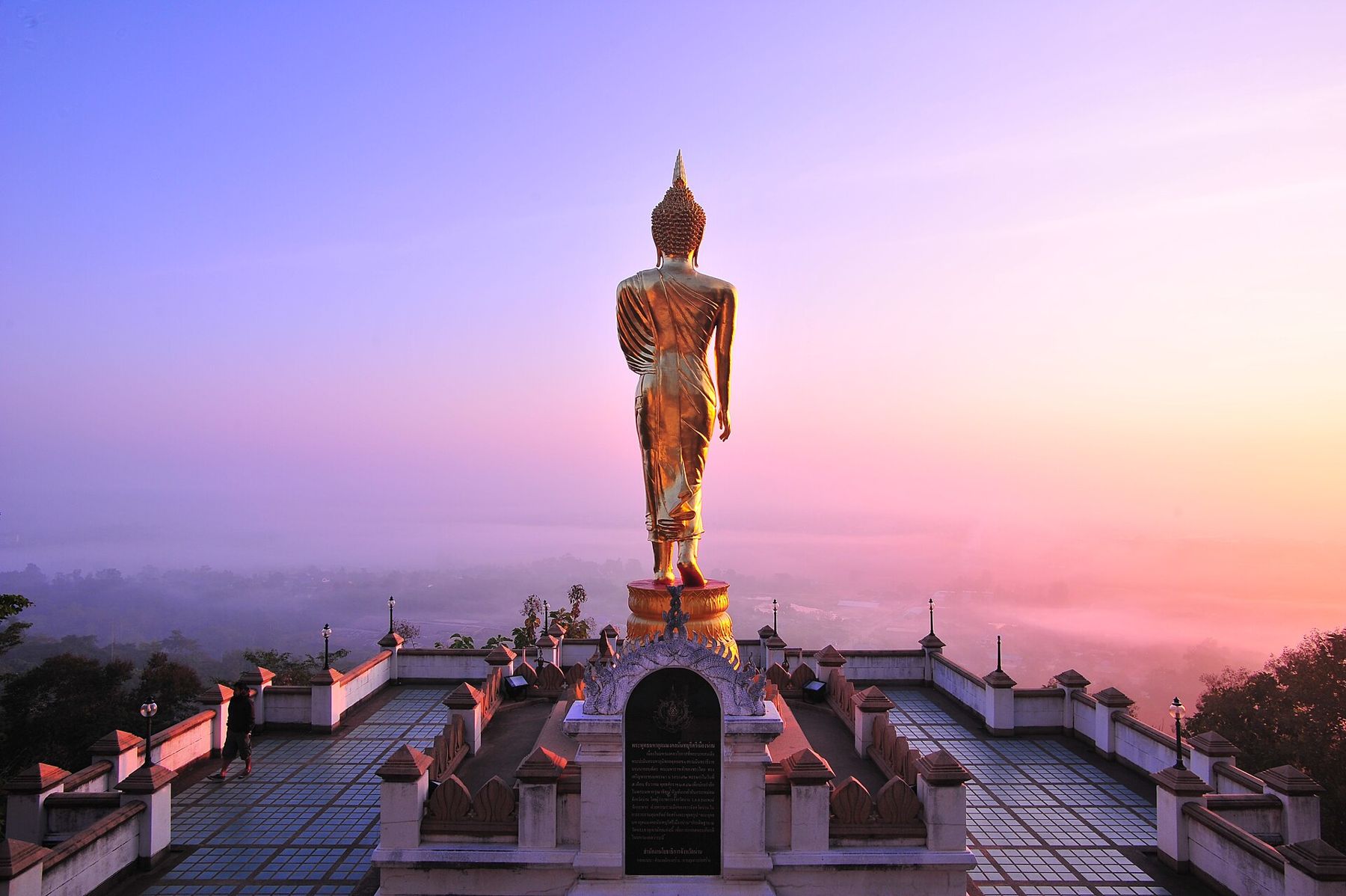
Check the time of sunrise or sunset before you go, and allow time to climb. The temple grounds are generally open through the day.
Reading the valley
From the terrace you can pick out the shape of Nan. The old town lies spread below, its temple roofs and the golden chedi of Wat Phra That Chang Kham showing among the trees. The river runs beyond, and on clear days you can make out the low hill of Wat Phra That Chae Haeng on the far side. Farther still, the mountains rise towards the national parks, and the road to Doi Phu Kha disappears into them.
The view changes with the seasons. In the rains the valley is a deep, wet green, with the paddy fields flooded and the clouds low on the hills. Towards the end of the year the rice turns gold and the air clears, giving the sharpest views of the cool season. Later in the dry season, haze from burning in the fields and forests of the north can blur the horizon for weeks, so the far ridges may vanish altogether.
It is a good place to plan the rest of a trip. Everything you can see from up here, from the paddy fields around town to the forested ridges on the horizon, is within a day's reach.
The hill is about two kilometres west of the old town. Cycling there is easy on the flat, though you will want to leave the bicycle at the foot if you take the steps. Local songthaews and tuk-tuks will take you to the top for a fare agreed in advance. Arrange a ride back if you go up for sunset, as transport can be thin after dark.
There is usually no fee to enter, though donations are welcome. Dress as for any temple, with shoulders and knees covered, and bring a light layer for winter dawns, when the hilltop can be surprisingly cool.
Before: Wat Ming Mueang · Next: Wat Phaya Wat · Same topic: Wat Phumin, Wat Phra That Chae Haeng, Wat Phra That Chang Kham, Wat Ming Mueang, Wat Phaya Wat, Wat Suan Tan · all notes
Images: Manoonp, CC BY-SA 4.0; Manoonp, CC BY-SA 4.0; k.phothiwijit, CC BY-SA 3.0.


